Don Quixote Reads Avellaneda’s Sequel and Avoids Zaragoza
Don QuixoteDon Quixote Reads Avellaneda’s Sequel and Avoids Zaragoza brings the conflict between the living knight and an unauthorized account of his adventures into the same room. At an inn, Don Quixote hears readers criticize the sequel to his history, then takes up the book and challenges its version of his life. His response is more than a defense of reputation: he treats constancy to Dulcinea and the accuracy of Sancho Panza’s name and family as tests of whether a history deserves belief. When the sequel also predicts his appearance at Saragossa, he changes his destination, turning its fictional claim into a route he can refuse.
An overheard reading becomes a confrontation
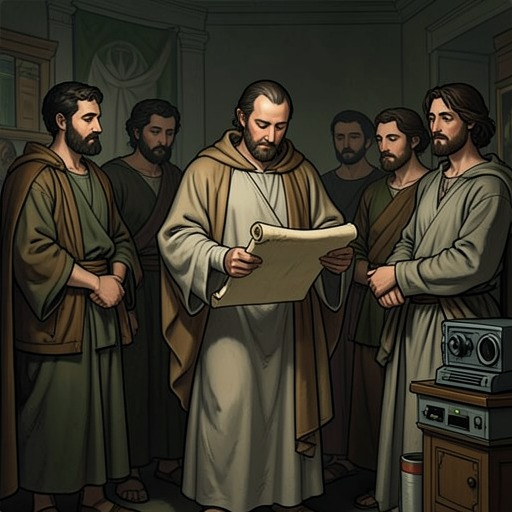
At supper, Don Quixote retires to his room with a stew-pan brought in by the landlord. A thin partition separates him from the adjoining room, where Don Juan asks Don Jeronimo to read another chapter of the Second Part of Don Quixote. Don Jeronimo objects that anyone who enjoyed the First Part could not take pleasure in this sequel. Don Juan is more willing to give it a hearing, but identifies one detail that particularly displeases him: the book says Don Quixote has recovered from his love for Dulcinea.
Hearing his own name and the discussion of his devotion, Don Quixote rises and answers from his room. He insists that Dulcinea cannot be forgotten and presents constancy as central to his identity and profession. Sancho promptly identifies the speaker, making the private exchange across the partition a face-to-face encounter. Two gentlemen enter; one embraces Don Quixote, recognizes him as the genuine knight, and gives him the book his companion has brought. The scene shifts from people reading about Don Quixote to Don Quixote reading about himself.
The sequel put to the test
Don Quixote examines the book rather than accepting the gentlemen’s praise. From the portions he looks over, he objects to wording in the preface, to its Aragonese language and omissions of articles, and, above all, to what he considers a consequential error in the history. The sequel calls Sancho’s wife Mari Gutierrez, whereas her name is Teresa Panza. Don Quixote argues that a writer who is wrong about such an important detail gives readers reason to doubt the rest of the account.
Sancho makes the error personal as well as historical. He protests that the author seems set against their agreement, and worries that the sequel may portray him as a glutton or even a drunkard. His reaction shows that the dispute concerns more than Don Quixote’s heroic image: Sancho, too, expects his character and household to be represented faithfully. The gentlemen invite Don Quixote to dine with them because, they say, the inn has little fit for a guest of his standing. He accepts; Sancho stays with the stew and eats alongside the landlord.
At supper, Don Juan asks after Dulcinea, including whether she is married or has had a child. Don Quixote replies that she remains a maiden, that his passion is firmer than ever, and that her beauty has been transformed into that of a country woman. He then recounts her enchantment, his experience in the Cave of Montesinos, and Merlin’s prescription for disenchanting her: Sancho must scourge himself. The gentlemen are entertained by the strange incidents, yet also struck by the elegance of Don Quixote’s manner. They see in him both wit and sense and an apparent fool, and cannot settle which better describes him. Sancho, returning after supper, again worries about the sequel’s portrayal of him.
A route chosen against the book
The conversation continues late into the night. Don Juan asks Don Quixote to read more of the sequel, but he refuses. He considers the book already judged and does not want its author to imagine that he has given it a full reading. His dismissal is a deliberate boundary: he will answer the sequel’s claims, but will not lend them further attention by continuing through it.
Asked where he plans to go, Don Quixote says Saragossa, where annual harness jousts are held. Don Juan reports that the new history describes Don Quixote competing there in a tilting at the ring, criticizing the episode as unimaginative and poor in mottoes and costume. Don Quixote immediately decides not to go. By choosing another destination, he intends to expose the sequel’s account as a lie and distinguish himself from the figure it describes. Don Jeronimo proposes the jousts at Barcelona instead; Don Quixote agrees, asks leave to retire, and counts the gentlemen among his friends. Sancho adds that he, too, may prove useful.
The decision carries into the journey
The next morning Don Quixote leaves the inn after checking the most direct way to Barcelona that avoids Saragossa. The narrator explicitly connects this care in choosing the road to Don Quixote’s wish to prove the new historian a liar. The encounter therefore changes the itinerary, not just the conversation: the knight’s conduct becomes a rebuttal to the sequel’s predicted episode.
For six days nothing worthy of record happens. After turning aside from the road, master and squire are overtaken by night among oak or cork trees. Sancho, who has eaten well at midday, falls asleep, while Don Quixote remains awake, his thoughts ranging back to the Cave of Montesinos and the transformed Dulcinea he believes he saw there. He grows angry at what he considers Sancho’s lack of effort, believing the squire has inflicted only five lashes against the many required for the disenchantment. He reasons that Sancho need not administer the lashes himself if the necessary number is received, and considers forcing him. The book dispute thus redirects their journey while leaving the older problem of Dulcinea’s enchantment—and Sancho’s resistance to its remedy—unresolved.
Narrative significance
The episode makes the sequel’s authority a matter to be tested through concrete details and actions. Don Quixote disputes its account of his love; the wrong name for Teresa Panza gives Sancho an equally tangible reason to distrust it; and the predicted tournament at Saragossa becomes something Don Quixote can disprove by refusing to appear there. The change of route makes literary disagreement part of the plot, as the knight acts in response to a version of himself already in circulation.
The contrast at supper complicates any simple distinction between sense and folly. Don Quixote’s certainty about enchantment and his proposed coercion of Sancho sit beside a precise objection to the sequel’s factual error and a clear decision about where to travel. The gentlemen are entertained but unable to classify him. His actions likewise refuse a single judgment: he protects the constancy he claims as his defining virtue, while pursuing that ideal through a world where stories, reputations, and experience continually contest one another.